7% maximum drawdown, 3% intraday drawdown: What exactly is EagleTrader Max testing in traders?

When many traders judge whether their trading is stable, their first reaction is often to look at the equity curve.
Whether they can sustain profits, how large the maximum drawdown is, and whether results remain controllable after a strategy has run for a period of time—these data indeed help us judge the performance of a trading strategy.
But true stability is not just about 'how much was ultimately earned.'
Whether existing gains can be protected after making a profit, whether risk can be controlled in time during consecutive losses, and whether trades can still be executed according to established rules after a single day's state changes—these also determine whether a trading system can operate over the long term.
In the EagleTrader Max mode, this kind of trading stability is placed into a clearer dynamic risk-control framework.
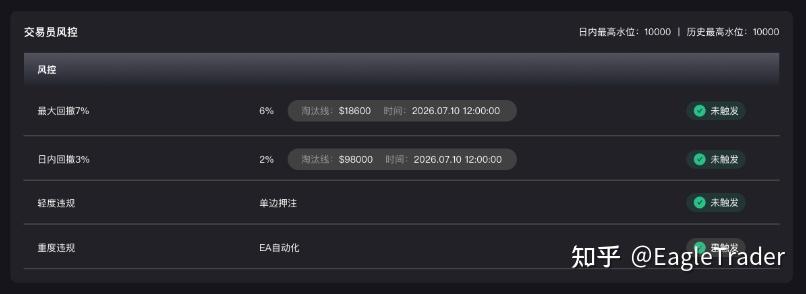
Max has two core real-time risk controls: maximum drawdown risk control (7%) and intraday drawdown risk control (3%).
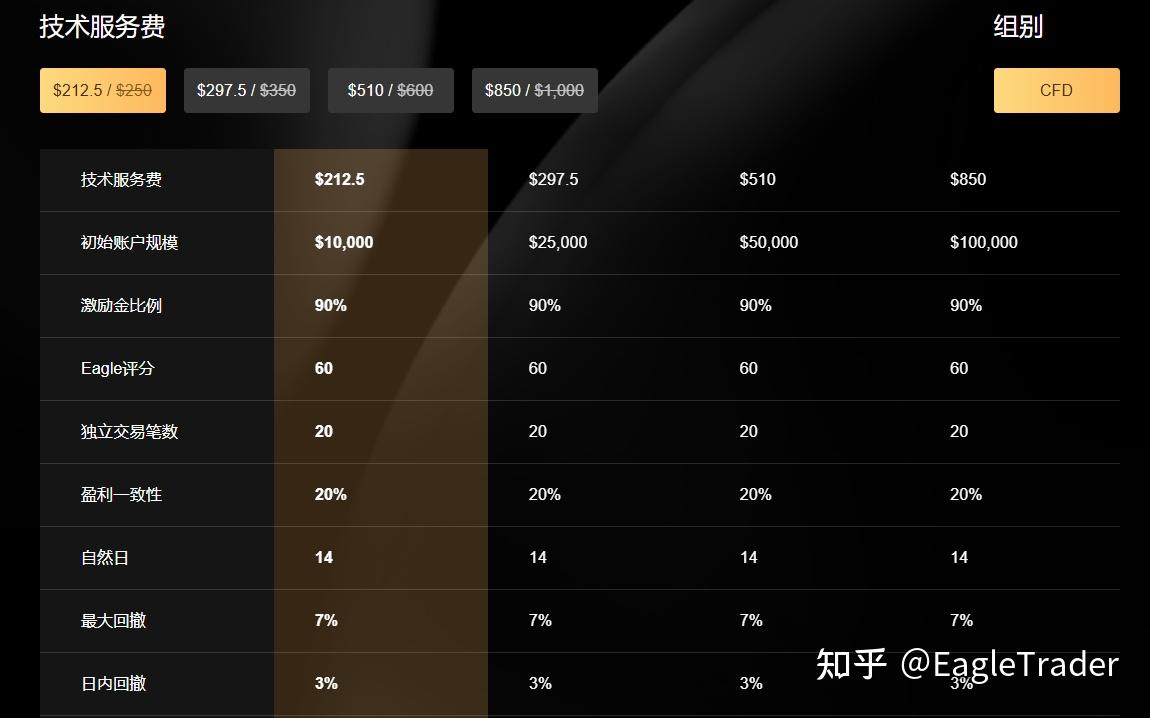
Unlike a fixed loss limit, these two risk-control lines change continuously with account performance.
Traders must not only generate profits, but also continuously manage positions, protect profits, and control risks across different time scales as the account changes.
7% maximum drawdown looks at whether the account can remain 'steady' over the long term
Max's maximum drawdown risk-control line is dynamically calculated based on the account's historical high-water mark. The 'water mark' here refers to the system's real-time recorded historical highest net value/balance of the account (taking the maximum value), which only rises and never falls.
The so-called maximum drawdown risk control means triggering when the account retraces downward from the historical high-water mark by 7% of the initial size. The calculation formula is:
Maximum drawdown risk-control line = historical high-water mark − initial account size × 7%
Assume a USD 100,000 account and the historical high-water mark rises to USD 109,000; then the maximum drawdown risk-control line = 109,000 − 100,000 × 7% = 102,000 USD.
Once this line is touched, an account risk-control violation is triggered.
This means that as the account continues to set new highs, the risk-management requirements traders face will also change.
Being able to grow the account in the early stage only proves that the trader has the ability to generate profits;
After the account becomes profitable, whether positions can be reasonably controlled to avoid giving back a large amount of profit due to one aggressive trade or a relaxation of risk standards better reflects whether the trading system is mature.
Therefore, the 7% dynamic maximum drawdown actually tests the trader's ability to manage positions, drawdowns, and profit protection over a longer cycle.
If a strategy can only rely on larger fluctuations to exchange for returns, then as the account's high point keeps rising, hidden risks will become increasingly easy to expose;
Conversely, a trading approach that can adapt to the dynamic drawdown line over the long term often means the trader has developed relatively stable risk-control habits.
3% intraday drawdown looks at whether the trading rhythm can be maintained within a single day
If the 7% maximum drawdown focuses more on long-term account performance, then the 3% intraday maximum drawdown further narrows risk control down to a single trading day.
The intraday water mark records the day's highest net value/balance from 00:00 platform time to 00:00 the next day, and it likewise only rises and never falls.
The so-called intraday drawdown risk control means triggering when the account retraces downward from the day's high-water mark by 3% of the initial size. The calculation formula is:
Intraday risk-control line = day's high-water mark − initial account size × 3% − user withdrawal (profit-share amount)
When the account sets a new high during the day, the intraday risk-control line will also adjust synchronously and be recalculated on the new trading day.
Once this line is touched, corresponding risk-control handling will likewise be triggered.
Particular attention should be paid to this: permitted withdrawals do not trigger intraday risk control; only the intraday risk-control line is adjusted accordingly, while the maximum drawdown risk control remains unchanged.
This exemption clause prevents traders from being mistakenly judged as violating risk control because they normally withdraw profits.
The 3% intraday dynamic risk control is not merely restricting traders.
For example, the market goes smoothly in the morning and the account has already made some profit, but the market environment changes in the afternoon.
If traders, because they have already made money earlier, start to increase position size and increase the number of trades in the hope of further expanding profits, then the profits already obtained may also be quickly given back because risk suddenly expands.
Another common situation occurs after consecutive losses.
A few stop-losses may not in themselves have a serious impact on the account, but if traders keep adding to positions and chasing orders because they are eager to recover losses, a normal strategy drawdown may gradually turn into emotional trading.
What these situations truly test is: whether the trader has a clear single-day risk boundary, and whether, as profits and losses keep changing, they can always execute according to their own trading system.
These details are often difficult to see from the final profit figure alone, yet they are reflected very directly in the process of account operation.
The two dynamic risk-control lines test two different kinds of stability
Putting 7% and 3% together actually forms a complementary mechanism at two time scales: 7% guards against long-term loss of control, while 3% guards against a single-day collapse.
A trader may have a good long-term strategy, but because of emotional loss of control after consecutive losses on a certain day, they expose single-day risk-management problems;
There are also traders whose daily trades appear very stable, but whose overall position structure is aggressive for a long time; only after the account's operating cycle continues to lengthen do the problems gradually emerge.
Therefore, Max mode's judgment of "stability" is not merely about whether a trader has reached a certain profit figure; it focuses more on the trader's sustained performance in single-day risk, overall drawdown, profit protection, and position management.
Profit is the result; stability is the foundation of long-term trading.
For traders who have already established a mature trading system, these rules are actually very intuitive.
How much risk one is willing to take at most in a day, how to adjust positions after the account becomes profitable, when to stop trading during consecutive losses, and how to protect existing profits—these rules that usually exist in a trading system will ultimately be genuinely reflected in the account results.
If you have enough confidence in your trading stability, you can also use EagleTrader Max to test your trading system within a clearer risk framework.
Ready to take on EagleTrader Max?
No upfront evaluation stage. Trade immediately once funded, with up to 90% profit split.