Why does focusing more on short-term profit and loss make it easier to disrupt the strategy?

The pain of losing 100 yuan and the joy of earning 100 yuan are never the same thing.
In 1979, Daniel Kahneman and Amos Tversky proposed in Prospect Theory that people are generally more sensitive to losses than to gains of the same magnitude.
In other words, the discomfort caused by a loss is often stronger than the satisfaction caused by an equivalent gain.
This is the later widely discussed Loss Aversion.
For example, a trade that should have been stopped out is held because one is unwilling to accept a loss; as soon as there is a small profit, one worries about giving back the gains and exits too early.
Trades that should have been handled according to the strategy begin to be influenced by the thought "I don't want to lose."
But there is a more subtle situation: the trader does not obviously resist stop-losses, and the strategy looks quite complete, yet they are still easily led astray by short-term gains and losses.
This brings us to another concept—myopic loss aversion.
From "fearing losses" to "caring too much about immediate losses"
In 1995, Shlomo Benartzi and Richard Thaler proposed "Myopic Loss Aversion."
They put two factors together:
First, people themselves have loss aversion; second, even when facing long-term goals, they frequently evaluate their asset performance.
Together, the two amplify the influence of short-term losses on people's decisions.
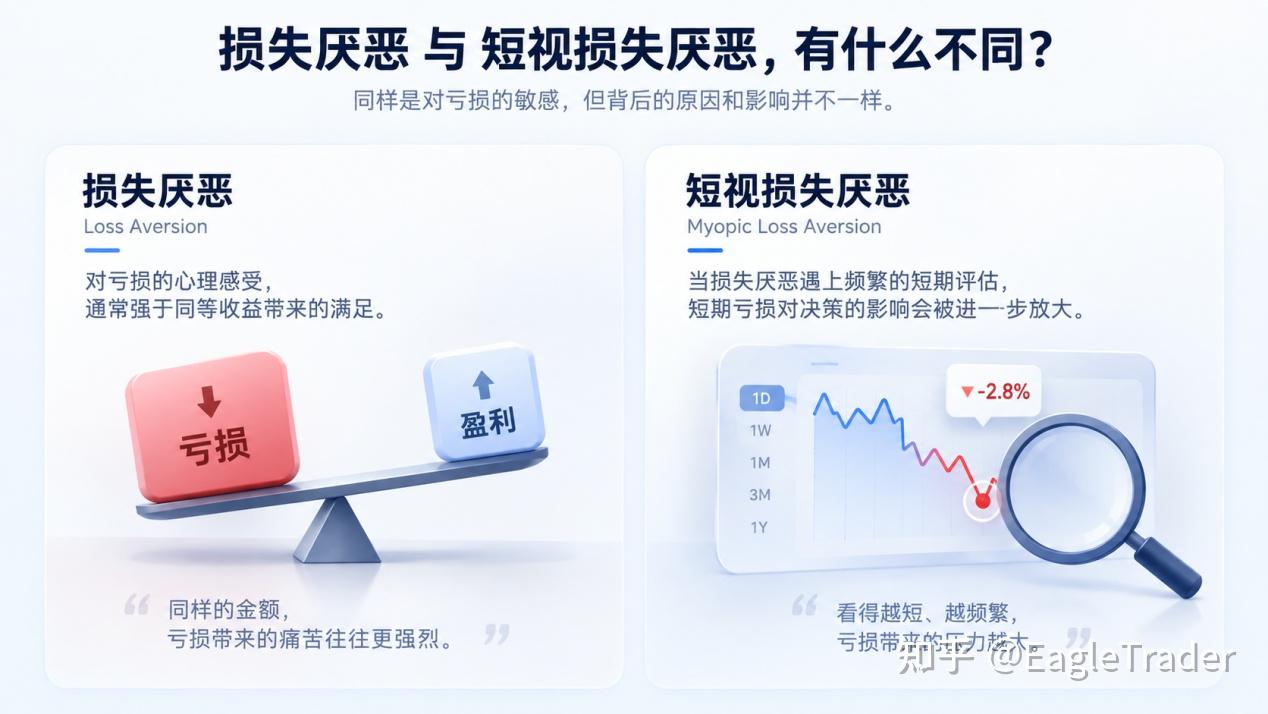
In a trading context, it can be understood a little more simply: the shorter your horizon, the more likely you are to treat a normal fluctuation as a problem that needs to be dealt with immediately.
For example, a strategy itself allows several consecutive stop-losses and is still effective over long-term statistics.
But if the trader rejudges "whether this strategy really works" after every trade, then after two or three consecutive losses, it is easy to start reducing position size, skipping signals, taking profits early, or even directly modifying the strategy.
The problem here is that what changes the trading plan at this point may not be the strategy's own failure, but simply the psychological pressure brought by short-term losses.
The same situation can also appear during profitable periods.
For example, as soon as the account has a small drawdown from a high point, one rushes to protect profits; seeing the day turn from profit into loss, one immediately wants to recover the loss.
A strategy originally designed around a complete cycle ends up becoming an immediate reaction to every account fluctuation.
Before the strategy has had time to prove itself, the trader changes it first.
It is hard to fight this with self-discipline, but rules can
The core variable of myopic loss aversion is evaluation frequency. The more frequently you look at results, the more easily you are led by short-term fluctuations.
But the problem is that self-discipline can hardly solve this—because frequently checking the market is itself behavior driven by loss aversion.
The more afraid of losses you are, the more you want to look; the more you look, the more afraid you become.
At this point, the value of proprietary trading becomes apparent.
It cannot eliminate loss aversion, nor will it automatically make traders rational.
But it can provide a clearer standard for judgment.

Take the proprietary trading EagleTrader Max instant account model as an example: the account has two layers of dynamic risk boundaries:
Maximum drawdown of 7%, calculated based on the account's historical high-water mark; intraday maximum drawdown of 3%, calculated based on the day's high-water mark.
The two rules focus on different time scales.
The 7% maximum drawdown requires traders to consider risk over the entire account cycle.
As the account keeps making new highs, the risk benchmark also changes accordingly, and position sizing and drawdown management need to continuously adapt to the account's state.
The 3% intraday drawdown, by contrast, sets a boundary for single-day risk.
Several losses within a day do not mean one must immediately "make it back"; what the trader first needs to consider is whether the remaining risk budget for the day can still support continued trading.
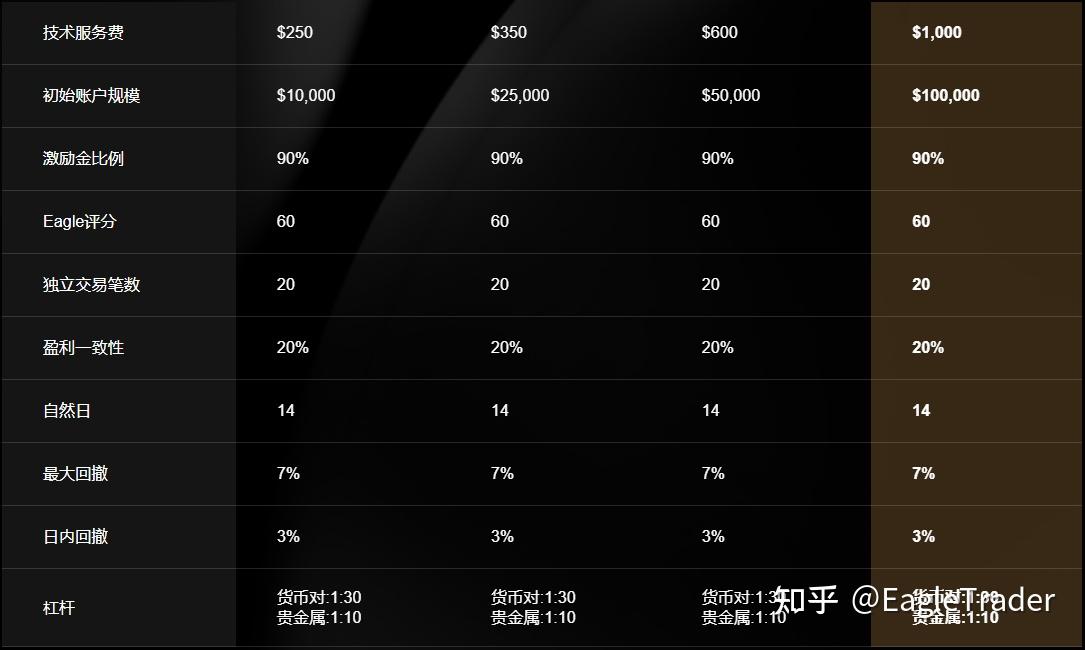
A very practical change brought by such rules is:
Traders need to gradually shift from "whether this trade makes or loses money" to "how much risk this trade uses and whether my strategy is still within the plan."
For people who are easily swayed by short-term gains and losses, this is actually a completely different trading perspective.
A strategy needs to be given enough time to prove itself
The most troublesome thing about myopic loss aversion is that it easily makes traders mistake "short-term experience" for "long-term results."
A one-day drawdown may just be ordinary fluctuation within a trading cycle.
If every loss triggers a strategy adjustment, then even the best system will find it hard to continue running completely according to its original logic.
Therefore, when testing trading ability, profitability itself is only part of the result.
Whether positions can be executed according to the established position sizing, whether losses within the range allowed by the strategy can be accepted, and whether one can persist for a period within clear risk boundaries will likewise affect the stability the account ultimately displays.
This is also why some proprietary trading firms, in their design, place "sustained consistency" ahead of "short-term profit targets."
For traders who already have a mature strategy, what they truly need to face when participating in proprietary trading is not the rules themselves, but whether, as short-term profits and losses keep appearing, they can still continue executing according to their original system.
Because in trading, what is sometimes hardest to control is not the next market move.
It is one's own next action after seeing the account numbers change.
Ready to take on EagleTrader Max?
No upfront evaluation stage. Trade immediately once funded, with up to 90% profit split.